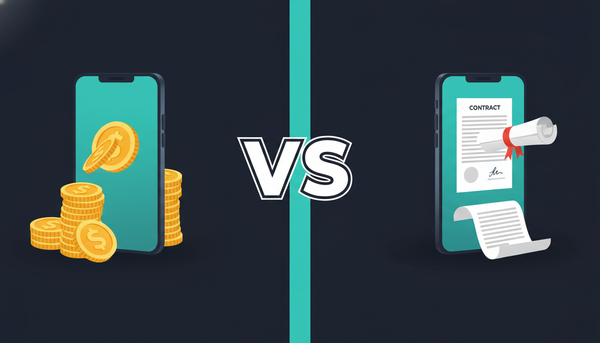
When choosing a phone plan, you'll face a fundamental decision: prepaid or postpaid? Each model has distinct advantages, and the right choice depends on your priorities, credit situation, and phone habits. This guide breaks down everything you need to know about prepaid vs postpaid plans in 2026.
What's the Difference?
Postpaid Plans
Postpaid is the traditional cell phone model. You sign up for service, use your phone throughout the month, and receive a bill afterward. Key characteristics:
- Pay for service after using it
- Usually requires a credit check
- Often includes device financing
- May involve service contracts
- Bill varies with overages or add-ons
- Typically with major carriers (AT&T, Verizon, T-Mobile)
Prepaid Plans
Prepaid flips the model: you pay upfront for your service before using it. Key characteristics:
- Pay before using service
- No credit check required
- Bring your own device or pay full price
- No contracts or commitments
- Fixed monthly cost
- Available from major carriers and MVNOs like Vouch Mobile
Prepaid vs Postpaid: Complete Comparison
| Feature | Prepaid | Postpaid |
|---|---|---|
| Credit check | No | Yes |
| Monthly payment | In advance | After usage |
| Contracts | None | Often 24-36 months |
| Device financing | Rarely | Common |
| Cost | Lower ($25-50/mo) | Higher ($50-90/mo) |
| Overages | None (service stops) | Possible charges |
| Network priority | Sometimes lower | Highest priority |
| Perks/extras | Limited | Often included |
| Early termination fees | None | Common |
| International roaming | Limited | More robust |
| Family plans | Varies | Usually available |
The Case for Prepaid Plans
1. No Credit Check Required
This is the biggest advantage for many people. Prepaid plans don't require a credit check, making them accessible regardless of your credit history. Whether you're:
- Building credit for the first time
- Recovering from financial difficulties
- Simply prefer not to have your credit pulled
Prepaid plans welcome you without judgment. Learn more about no credit check phone plans.
2. Lower Monthly Costs
Prepaid plans typically cost 30-50% less than comparable postpaid plans. For example:
| Carrier Type | Unlimited Plan Cost |
|---|---|
| Verizon postpaid | $80-90/month |
| AT&T postpaid | $75-85/month |
| T-Mobile postpaid | $70-80/month |
| Prepaid unlimited | $25-50/month |
That's savings of $300-600+ per year for comparable unlimited service.
3. No Contracts or Commitments
Prepaid plans operate month-to-month. You can:
- Switch carriers anytime
- Cancel without penalties
- Change plans freely
- Port your number when you want
This flexibility is valuable in a fast-changing wireless market.
4. No Surprise Bills
With prepaid, you know exactly what you'll pay each month. There are no:
- Overage charges
- Mysterious fees that appear on bills
- Variable costs from data overuse
- Surprise international charges
If you use all your data, service simply slows or stops rather than racking up extra charges.
5. Better for Budget Management
Prepaid makes phone expenses predictable. If budget control is important to you, knowing your exact phone cost every month makes financial planning easier.
The Case for Postpaid Plans
1. Device Financing
The primary advantage of postpaid is the ability to finance expensive phones. A $1,200 iPhone becomes $33/month over 36 months. This makes flagship devices accessible without large upfront payments.
However, remember: you're paying full price plus interest, and you're locked in until it's paid off.
2. Network Priority
On some carriers, postpaid customers receive network priority over prepaid during congestion. This means potentially faster speeds in crowded areas like stadiums, concerts, or busy urban centers.
The practical difference is often minimal, but it exists.
3. More Robust Perks
Postpaid plans frequently include extras like:
- Streaming subscriptions (Netflix, Hulu, Disney+)
- International roaming packages
- Cloud storage
- Wi-Fi hotspot in airports/hotels
- Device protection plans
Whether these perks justify the higher cost depends on your usage.
4. Family Plan Discounts
While prepaid carriers increasingly offer multi-line discounts, postpaid plans traditionally have stronger family plan pricing. If you're adding 4-5 lines, postpaid family plans can be competitive per line.
5. Easier Device Upgrades
Postpaid makes phone upgrades simple. Trade in your old phone, start a new financing agreement, and get the latest device. Prepaid typically requires purchasing phones outright or through separate financing.
Who Should Choose Prepaid?
Prepaid plans are ideal if you:
- Want the lowest monthly cost - Savings of $25-40/month add up to hundreds per year
- Have limited or no credit history - No credit check means instant approval
- Prefer no commitments - Month-to-month flexibility without contracts
- Already own a phone - No need for device financing
- Want budget predictability - Same bill every month, no surprises
- Don't need the latest perks - Streaming bundles aren't important to you
- Travel domestically primarily - Domestic coverage is identical to postpaid
Who Should Choose Postpaid?
Postpaid plans make sense if you:
- Need to finance an expensive phone - Can't pay $1,000+ upfront
- Want premium perks - Streaming bundles, international roaming, etc.
- Have multiple family lines - Family discounts can offset higher base prices
- Need absolute network priority - Can't tolerate any speed reduction
- Travel internationally often - Need robust international roaming
- Have excellent credit - Can qualify for the best postpaid offers
The Rise of Prepaid MVNOs
Much of prepaid's growth comes from MVNOs (Mobile Virtual Network Operators). These companies don't own network infrastructure but lease it from major carriers.
MVNOs like Vouch Mobile, Mint Mobile, Visible, and Cricket offer the same network coverage as big carriers at significantly lower prices. The trade-offs are typically:
- Fewer retail store locations
- Less included perks
- Potentially lower network priority (varies by MVNO)
For many users, these trade-offs are worth the substantial savings.
Common Myths About Prepaid Plans
Myth: Prepaid has worse coverage
Reality: Prepaid carriers use the same towers as their parent networks. Vouch Mobile uses AT&T's network, so coverage is identical to AT&T's coverage.
Myth: Prepaid is only for people with bad credit
Reality: Many people with excellent credit choose prepaid to save money. No credit check is a feature, not a requirement born of necessity.
Myth: You can't get unlimited data on prepaid
Reality: Most prepaid carriers offer unlimited data plans. They're often cheaper than postpaid unlimited plans.
Myth: Prepaid phones are inferior
Reality: You can use any compatible unlocked phone on prepaid, including the latest iPhones and Samsung flagships.
Myth: You can't keep your number on prepaid
Reality: Number porting works the same regardless of prepaid or postpaid status. Your number transfers seamlessly.
The Hybrid Approach
Some people use a combination strategy:
- Postpaid for primary phone - Finance a flagship device with postpaid
- Prepaid for secondary lines - Kids, tablets, or backup phones on prepaid
This balances device financing needs with cost savings on additional lines.
How to Switch from Postpaid to Prepaid
Ready to make the switch? Here's the process:
- Pay off your device - If you're financing a phone, pay the remaining balance
- Unlock your phone - Request an unlock from your carrier
- Choose a prepaid carrier - Compare options and coverage
- Port your number - Transfer your existing number to the new carrier
- Activate service - Insert your new SIM or eSIM
The entire process can be completed in a day. See our full guide on how to switch phone carriers.
Frequently Asked Questions
Can I switch from postpaid to prepaid?
Yes, you can switch anytime. You'll need to pay off any device financing first and unlock your phone. Then simply sign up for a prepaid plan and port your number over.
Is prepaid data slower than postpaid?
In most situations, speeds are comparable. During severe network congestion, some carriers prioritize postpaid traffic, but this affects a small percentage of users in limited situations.
Do prepaid plans build credit?
Standard prepaid plans do not report to credit bureaus, so they won't build credit. Some postpaid carriers offer "credit-building" features that report payment history.
Can I get a phone with a prepaid plan?
Some prepaid carriers sell phones, but device financing is limited. Most prepaid users bring their own unlocked devices or purchase phones at full retail price.
Are there hidden fees with prepaid plans?
Reputable prepaid carriers advertise all-in pricing with taxes and fees included. Always verify what's included before signing up.
Ready to Switch to Prepaid?
If lower costs, flexibility, and simplicity appeal to you, prepaid is worth serious consideration. The days of prepaid being "lesser" service are long gone.
Vouch Mobile offers prepaid unlimited plans starting at just $25/month (annual billing) on AT&T's network. No credit check, no contracts, and no surprises. You get the same AT&T coverage as customers paying twice as much.
Compare our plans and see how much you could save by switching to prepaid. Your wallet will thank you.